

You may also be interested in…
If you are looking for driving instructors in Stirling, you may also be interested in driving lessons in Menstrie, driving schools in Dunblane, or driving instructors in Alloa, Clackmannan. Each has distinct driving conditions and test centre options worth considering.
Driving Instructors In Stirling - Learning to Drive in Stirling
Looking for driving schools in Stirling or driving instructors in Stirling? You have come to the right place. Whether you need driving lessons near me, automatic driving lessons near me, or manual driving lessons near me, our approved driving instructors are here to help.
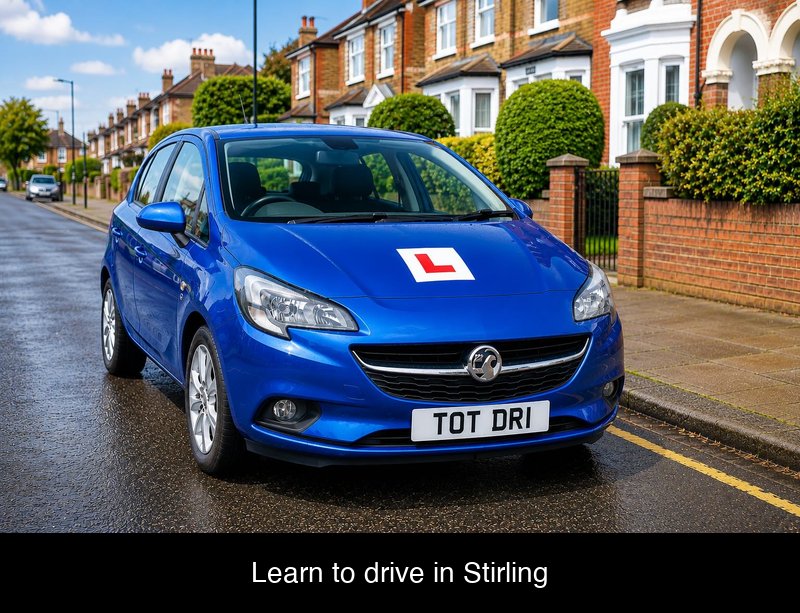
On average, learners require around 47 hours of professional tuition before passing their practical driving test. In addition, experts recommend a further 22 hours of private practice with a family member or friend. Consequently, combining professional lessons with private practice can help learners progress more quickly and confidently.
Stirling’s nearest practical test centre is Stirling Driving Test Centre, which has a pass rate of 38.7%—below the national average of 48.7%. Alternatively, learners may choose Grangemouth Driving Test Centre, where the pass rate is 46.4%. Alternatively, Bishopbriggs Driving Test Centre has a pass rate of 50.5%.
Therefore, when comparing driving instructors in Stirling, it is worth asking which test centres they regularly prepare learners for. After all, practising on local roads and common test routes can make a noticeable difference to your confidence and performance on test day.
Stirling is located in Scotland, where you’ll encounter highland roads, A-road dual carriageways, and suburban streets. The M8, M9, A9 and A90 are key routes in the area.
The nearest practical test centres are Stirling and Grangemouth. The area experiences cold winters with snow and ice on untreated roads, which can affect driving conditions. During peak hours, traffic congestion builds on main routes into city centres. Your driving instructor will guide you through all these conditions as part of your preparation for the practical driving test.
Whether you are searching for car driving lessons near me, driving lessons near me automatic, driving lessons automatic near me, or driving lesson near me, you will find experienced instructors who can support your learning journey.
Similarly, whether you are looking for cheap driving lessons near me, affordable driving lessons near me, or the best driving lessons near me, choosing an instructor with strong local knowledge can improve your chances of passing first time.
Stirling Practical Driving Test Centres
The 3 nearest practical test centres to Stirling are:
- Stirling Driving Test Centre, Government Buildings, Stirling, FK8 2HF – Google Maps
- Grangemouth Driving Test Centre, Unit 7
Grangemouth Business Centre, Grangemouth, FK3 8WJ – Google Maps - Bishopbriggs Driving Test Centre, Crosshill Road, Glasgow, G64 2QA – Google Maps
Stirling Theory Test Centres
The 3 nearest theory test centres to Stirling are:
- Pearson Professional Centre Stirling, Ground Floor, Lomond Court, Stirling, FK9 4TU – Google Maps
- Pearson Professional Centre Glasgow, Third Floor, Empire House, Glasgow, G1 2RX – Google Maps
- Pearson Professional Centre Tain, Main Function Suite, Ground Floor, Royal Hotel, Tain, IV19 1AB – Google Maps
Quick Links
- Book your driving test
- Book your Theory Test
- Change your driving test appointment
- Driving test: cars
Frequently Asked Questions About Learning to Drive in Stirling
- How do I find a driving instructor in Stirling? Looking for driving instructors near me in Stirling? Find ADI-qualified driving instructors in Stirling on our dedicated driving instructors page. Look for driving instructors offering manual driving lessons or automatic driving lessons who know the local test routes.
- What is the practical driving test pass rate near Stirling? The national average practical test pass rate is 48.7% (49.5% for males, 47.6% for females).
Stirling’s nearest test centres and their pass rates:
Stirling — 38.7% pass rate (male 38.2%, female 39.1%)
Grangemouth — 46.4% pass rate (male 45.8%, female 47.1%)
Bishopbriggs — 50.5% pass rate (male 49.2%, female 52.1%)
Your driving instructor in Stirling will prepare you for the specific routes and manoeuvres most likely to appear on test day at your chosen centre. - How much do driving lessons cost in Stirling? The national UK average driving lesson price sits between £35 and £40 per hour for standard manual driving lessons. Automatic driving lessons generally cost slightly more, ranging from £38 to £45 per hour. Block bookings typically reduce the per-lesson cost.
- What driving lesson types are available in Stirling? Driving instructors offer manual and automatic driving lessons, intensive driving courses, refresher driving for nervous or returning drivers, and motorway driving lessons for new licence holders.
- How long does it take to learn to drive in Stirling? The national average is 47 hours of professional driving lessons plus 22 hours of private practice. Actual time depends on your confidence, lesson frequency, and local driving conditions.
- What are the driving conditions like in Stirling? Stirling is a Central Scottish city with a dense urban road network, complex junctions, and significant traffic volumes. Driving here provides excellent experience in real-world traffic situations that build confidence and competence. Learners must master multi-lane roundabouts, traffic light sequences, bus lanes, one-way systems, and busy pedestrian crossings. The Stirling test centre is 0.4 miles away, with routes navigating the city’s diverse road network. Peak commuting hours bring heavy congestion, while quieter periods offer ideal conditions for practising manoeuvres. Your driving instructor will tailor lessons to build your confidence progressively.
Report an Error
If you spot something wrong on this page — an incorrect address, a broken map link, a wrong pass rate, or anything else — please let us know.