


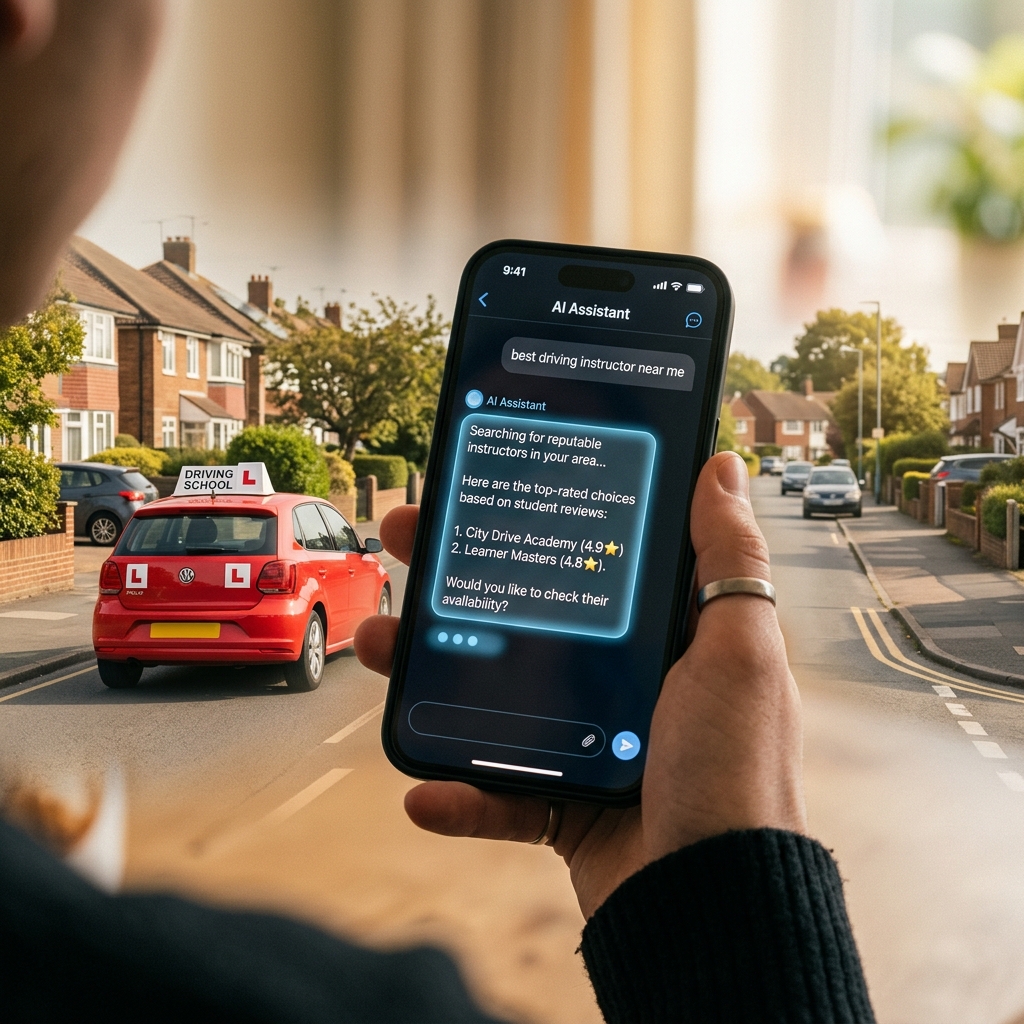
A stat has been quietly doing the rounds in marketing circles, and if you’re a driving instructor, it should stop you in your tracks.
According to research highlighted by Footsteps Design and the Driving School Marketing Hub, 45% of consumers now use AI tools — such as ChatGPT, Google’s AI Overviews, or Perplexity — to find local business recommendations. That figure stood at just 6% a year ago. In twelve months, the share of people turning to AI for “who should I use locally?” has increased more than sevenfold.
That is not a gradual shift. That is a rupture.
And for driving instructors — a profession built almost entirely on local reputation and word-of-mouth — understanding what this means is no longer optional.
What’s Actually Happening
When a 17-year-old sits down tonight and types “best driving instructor near me” into ChatGPT, or asks Google’s AI Overview to suggest someone local, what happens next is not the same as a traditional Google search from five years ago.
Instead of returning a list of ten blue links and letting the user sift through them, AI tools synthesise information and make a recommendation — often naming one or two businesses directly, or producing a short ranked list with brief reasoning. The user doesn’t visit six websites and compare. They read a paragraph and make a decision.
The question is: where does that AI get its information?
The answer, broadly, is this: AI recommendation engines draw on the same ecosystem of signals that have always mattered for local SEO — Google Business Profiles, review platforms, website content, directory listings, social mentions — but they weight and interpret them differently. An AI isn’t just counting stars. It is reading reviews, synthesising themes, assessing freshness, and judging credibility. And it is doing all of this invisibly, before the pupil ever lands on your website.
This means the game hasn’t changed entirely — but the stakes attached to getting it right have risen dramatically.
Why Driving Instructors Are Particularly Exposed
Most professions have some buffer. A restaurant, a hotel, or a retailer might reach potential customers through multiple channels: social media, paid advertising, PR, influencer content, walk-in footfall.
Driving instructors, by contrast, are almost entirely dependent on local discoverability. You can’t serve a customer 40 miles away. You live and die by what happens when someone in your postcode goes looking for lessons.
Historically, that meant word-of-mouth referrals and, more recently, showing up in Google Maps or local search results. Both of those still matter — but AI tools are rapidly inserting themselves into the top of that funnel. Before the pupil checks Google Maps. Before they ask a friend. They might ask ChatGPT first.
If you’re not visible to AI, you may never appear in a shortlist that a potential pupil even knew existed.
What AI Tools Actually Look For
Understanding what signals feed into AI-generated local recommendations helps you know where to focus your effort. Based on what’s publicly known about how these systems work, the following factors are consistently important:
Google Business Profile completeness and currency
Your Google Business Profile is one of the primary data sources AI tools draw on for local business information. A profile that hasn’t been updated in two years, has incorrect hours, or is missing photos and service descriptions is a weak signal. AI systems tend to favour businesses that look active and credible. Keep your profile current: update your service areas, add photos regularly, and make sure your contact details and categories are accurate.
Volume and recency of reviews
This is perhaps the single most important factor. AI tools don’t just count stars — they read the text of reviews and use them to build a picture of what you’re like to work with. A driving instructor with 80 reviews, the most recent posted last week, and a consistent pattern of comments about patience, clear explanations, and passing rates will be surfaced far more confidently than one with 15 reviews, the last from 18 months ago.
Recency matters as much as volume. A steady trickle of new reviews signals an active, ongoing business. A cluster of old reviews followed by silence can look like a business that’s wound down or coasting.
Review content and specificity
Generic five-star reviews (“great instructor, would recommend!”) carry less weight than detailed ones that mention specific qualities (“she explained the manoeuvres really clearly and I passed first time — her feedback after each lesson was genuinely useful”). Encourage pupils to leave thoughtful reviews. A gentle nudge after a pass, or a message asking them to share their experience if they found the lessons helpful, can make a real difference.
Website content and authority
If you have a website, the content on it matters. Pages that clearly describe your services, your location, your qualifications (ADI badge, specialisms like Pass Plus or motorway lessons), and your approach to teaching give AI systems more to work with. Thin websites with just a phone number and a contact form are essentially invisible.
Consistency across platforms
Your name, address, and phone number should be identical across your Google Business Profile, your website, any directory listings (Yell, Thomson Local, driving instructor directories), and your social profiles. Inconsistencies create doubt and reduce the confidence with which AI systems surface your details.
Social proof beyond Google
Reviews on Facebook, Trustpilot, or driving instructor-specific platforms like Trustist all contribute to the broader picture. You don’t need to be on every platform, but having some presence beyond Google alone strengthens your overall footprint.
What This Looks Like in Practice
Consider two instructors operating in the same town.
Instructor A qualified eight years ago. She built a solid reputation through referrals, has a modest website she set up in 2019, a Google Business Profile with 22 reviews (average 4.6 stars, last review 11 months ago), and no social media presence. She’s been full for years and hasn’t needed to think much about marketing.
Instructor B is three years qualified. He has 61 Google reviews (average 4.8 stars, newest from last Tuesday), regularly updates his Google Business Profile with posts and new photos, has a clean website with dedicated pages for different lesson types, and asks every pupil who passes to leave a review. He’s also on a couple of driving instructor directories.
A pupil typing “driving instructors in [town]” into ChatGPT or encountering Google’s AI Overview is significantly more likely to see Instructor B’s name — not because he’s better at teaching, but because the signals surrounding his business are fresher, richer, and more credible to an AI system.
Instructor A may not even notice the shift until her diary starts to thin out.
The Action List: What to Do Right Now
The good news is that the foundations of AI visibility are the same as the foundations of good local SEO — so the work you do here compounds across every channel. You don’t need a sophisticated strategy. You need to get the basics right and maintain them consistently.
- Audit your Google Business Profile today. Log in and check: Is your category set correctly (Driving School)? Are your service areas accurate? Are your photos recent? Have you written a business description? Are your hours correct? Fix anything that’s stale or missing.
- Build a review generation habit. After every pass, ask your pupil to leave a review. Make it easy — send them a direct link to your Google review page. Some instructors include this in a congratulations message. Others ask in person. Find whatever feels natural to you, and be consistent. Aim for at least a couple of new reviews per month.
- Respond to your existing reviews. AI systems note whether businesses engage with reviews, and responses also show future pupils that you’re attentive and professional. A brief, warm response to each review — especially to any less-than-perfect ones — is worth the five minutes it takes.
- Give your website some attention. Even a simple website benefits from clear, specific content. Write a page that describes your approach to teaching, your qualifications, the areas you cover, and the types of lessons you offer. Update it occasionally — even a short news section or a blog post once a quarter signals an active business.
- Check your details are consistent. Google your business name and your phone number. Look at every listing that appears. Make sure the name, address or service area, and phone number are identical everywhere. Correct any discrepancies.
- Don’t ignore directories. Getting listed — or updating your existing listing — on a couple of reputable driving instructor directories and local business directories takes an hour and adds to your overall signal footprint. It’s a low-effort, one-time task with lasting benefit.
A Word on Perspective
None of this is cause for panic. Referrals still work. Existing pupils still recommend instructors to siblings and friends. And many of the fundamentals — being a good teacher, having a flexible diary, offering fair pricing — haven’t changed at all.
But the channel through which new pupils first encounter your name is shifting, and it’s shifting fast. Going from 6% to 45% of consumers using AI for local recommendations in a single year is the kind of change that tends to catch people off guard precisely because the effects are invisible until they aren’t.
The instructors who will be best placed over the next few years are not necessarily the ones who embrace every new technology or spend a fortune on advertising. They’re the ones who treat their online presence as a live, maintained asset rather than a box ticked once and forgotten — who accumulate reviews steadily, keep their information current, and make it easy for the next generation of AI tools to recognise them as credible, active, and trusted.
That work is not glamorous. But it is increasingly the difference between a full diary and a quiet one.
Sources: Footsteps Design, Driving School Marketing Hub