


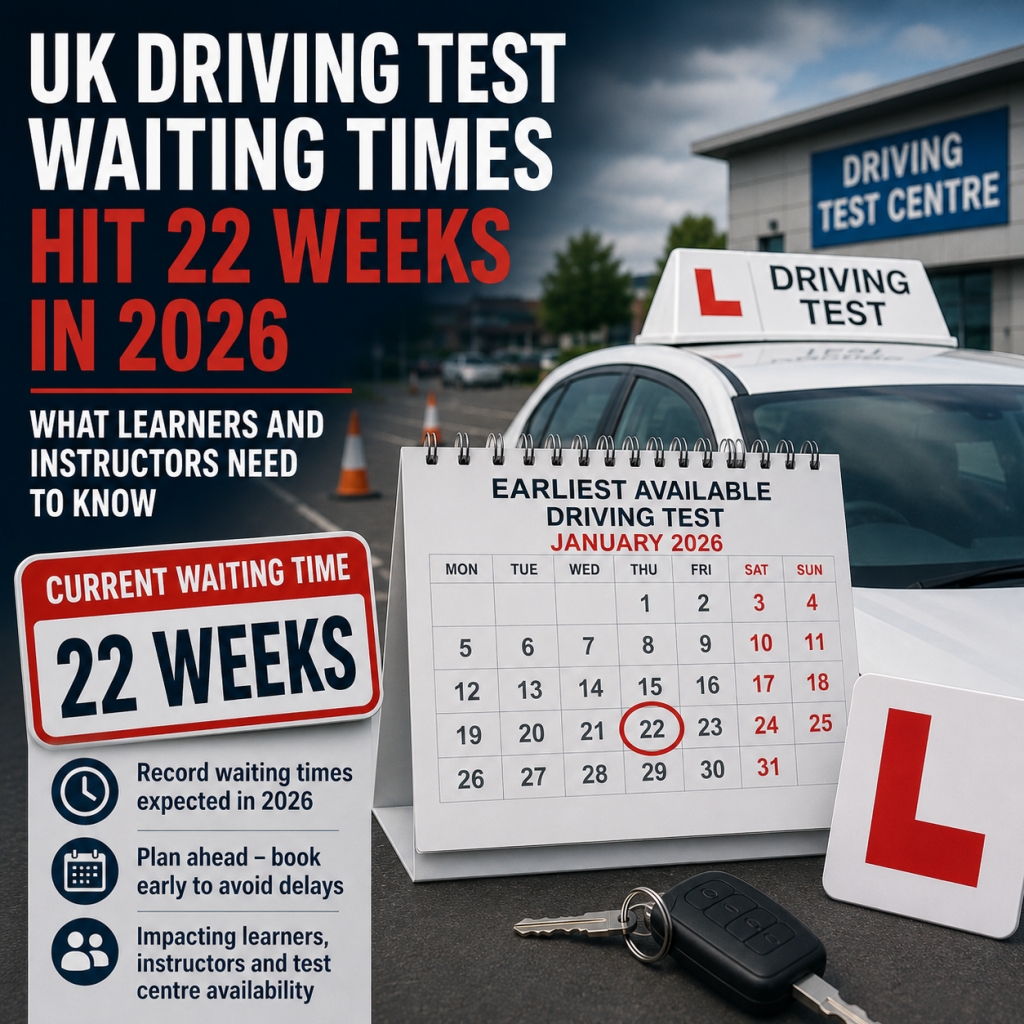
If you’re waiting for a driving test slot right now, you’re not imagining it — the queue really is that long. New data for 2026 shows the average wait for a UK practical driving test has climbed to 14–22 weeks nationally, with some London centres pushing past 25 weeks. Meanwhile, the national pass rate sits at just 48.7%. That’s a lot of waiting, and nearly half of candidates failing when they finally get there.
Here’s what the latest figures mean — and what both learners and instructors can do about it.
How Long Are UK Driving Test Waiting Times in 2026?
According to data compiled from DVSA statistics, the picture varies enormously depending on where you are:
- London and South East: Major centres including Belvedere, Mitcham, and Tolworth are showing waits of 12–16 weeks at minimum, with outer London areas stretching to 25+ weeks.
- Midlands: Coventry, Leicester, and Nottingham typically run 8–12 weeks behind.
- Northern cities: Leeds, Liverpool, and Newcastle are seeing similar demand, with pressure intensifying between June and September as school leavers enter the system.
- Rural areas: Centres in Somerset, Lincolnshire, Cumbria, and Norfolk regularly have appointments within 2–4 weeks.
The DVSA’s own target is a six-week wait. The current reality is more than double that in most parts of England. In 2024–25, the agency conducted around 1.84 million practical car tests — yet availability still can’t keep pace with demand.
The Pass Rate Problem: Nearly Half of Learners Are Failing
The UK’s overall pass rate for 2024–25 was 48.7%, with first-time candidates averaging 48.9%. That means for every two people who sit the test, roughly one goes home without a licence.
Regional variation is stark. Scotland passes at around 55%, while England averages 47%. Individual centres tell an even wider story: Hexham tops the table at 66.9%, while some busy London centres drop as low as 34%. Urban test routes — heavier traffic, complex junctions, more opportunities for critical errors — account for much of the difference.
There’s a silver lining in the data, though. Average lesson hours have risen from 41 hours in 2022–23 to 44 hours in 2024–25, and that’s the single strongest predictor of passing. More preparation genuinely works.
What This Means for Learner Drivers
If you’re learning to drive right now, the key is planning ahead — not just for test day, but for when to book.
- Book as soon as you’re approaching test-ready. A 14–22 week wait is a long time, but it can work in your favour: book when you’ve completed the bulk of your lessons, and use the remaining weeks to consolidate rather than rush.
- Watch for cancellations. When a learner cancels with 10+ working days’ notice, their slot briefly appears in the DVSA booking system before being reallocated. Checking regularly can land you a slot months earlier than your original date.
- Consider less busy test centres. Since June 2026, DVSA rules mean you can only move a booking to one of the three nearest centres to your original slot. But if you’re flexible about where you take your test, a neighbouring town’s centre might have far shorter waits.
- Don’t rush into booking. Under the new 2026 DVSA rules, you’re only allowed two amendments to a booking. Use them wisely.
What This Means for Driving Instructors
The long wait creates a specific challenge for ADIs: keeping pupils engaged, motivated, and improving over a 14–22 week gap between lessons ramping down and test day arriving.
- Plan lessons around the wait. Once a pupil is broadly test-ready, shift the focus to consistency and confidence rather than introducing new skills. The extra weeks are an opportunity to iron out minor faults, not a reason to stop lessons.
- Talk about the pass rate honestly. A national figure of 48.7% isn’t doom and gloom — it’s a reminder that preparation matters. Pupils who log more hours with a good instructor have consistently better outcomes. Use the data to set realistic expectations and reinforce the value of thorough training.
- Help pupils navigate the new booking rules. Since May 2026, only learners can book or amend their own tests. You can no longer do it for them, but you can guide them through the process — what to look for, when to check for cancellations, and how to use their two permitted changes wisely.
- Consider whether your local test centre is affecting results. If you operate near a low-pass-rate urban centre, it may be worth running additional mock tests on routes that mirror the real test’s complexity. Familiarity with the actual roads makes a measurable difference.
Will Waiting Times Improve in 2026?
The DVSA has been working to increase examiner capacity and reduce backlogs, but progress has been slower than many in the industry would like. The new booking rules — limiting amendments and restricting location transfers — are partly designed to free up slots that were being “hoarded” by learners booking multiple tests or securing distant appointments speculatively. Whether that frees up meaningful capacity remains to be seen.
For now, the practical advice is the same: book early, prepare thoroughly, and don’t rely on a last-minute scramble to get a test slot.
Ready to Get Started? Total Drive Can Help
At Total Drive, we help learner drivers across the UK get fully test-ready — with qualified, experienced instructors who know exactly what the examiner is looking for. If you’re looking for driving lessons that give you the best possible chance of passing first time, get in touch with us today and let’s get you on the road.
Sources: DVSA official statistics (DRT122A data, 2024–25); PassRates.uk; ExamRoutes.co.uk; DriveSim.uk; DriveSooner.co.uk, June 2026.